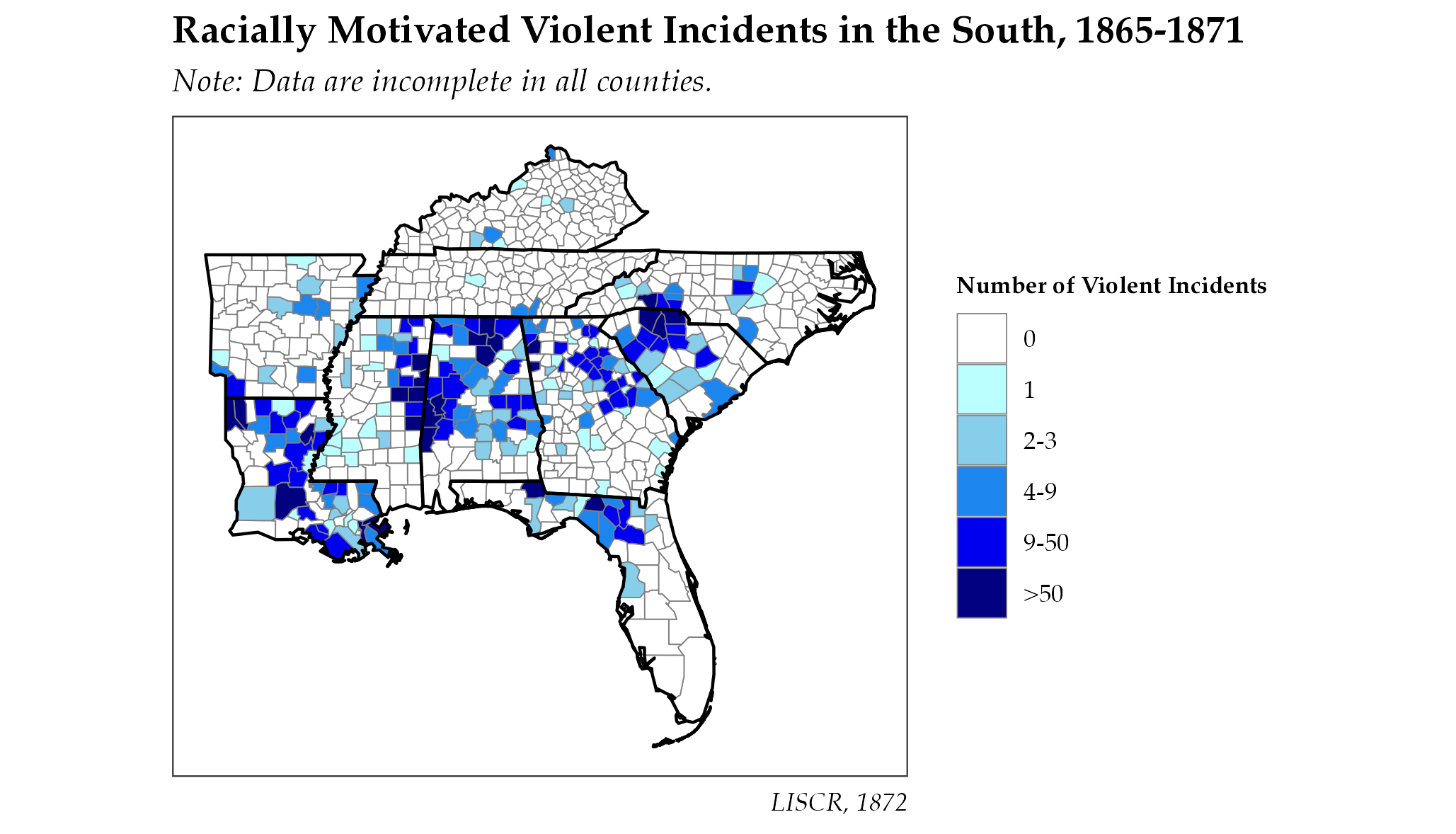
As mentioned on the landing page, my work encompasses several related areas related to the study of conflict. While the main area I’ve done work on so far has been the United States, I’m interested more broadly in any area where white supremacy or white nationalism has, or continues to rear, its ugly head. To that extent, you might find yourself interested in either of the working papers detailed below, or maybe even in some of the “where Alex is going next when he’s not knee-deep in the dissertation” stuff.
To answer the question you might have: I study why white supremacy and white nationalism continue to exist, how they challenges the state and impel and promote (or not) political violence, and what states do about that not because I find the answers incredibly heartening. I examine them because I’m fascinated by them as someone who came-of-age in the shadow of Charlottesville and Black Lives Matter, and who understands the divisiveness and power of white violence, both historically and contemporarily, to shape politics around it.
Working Papers
“Forged In Firing”: The Creation of Identity in the Aftermath of Civil War
Working Paper Draft | Draft Appendices
Scholars of civil conflict have long sought to develop a unified theory of post-conflict political behavior surrounding identity and memory. In this article, I propose a process by which groups use their personal and collective memory of wartime experiences to craft boundaries between themselves and out-groups which did not experience that boundary. I contend that one way to observe this process is through a physical manifestation of this collective memory: monument construction. Using the American South in the aftermath of the American Civil War as the exemplar case, I test this. I find that while physical manifestations had different effects in the aftermath of the War, these effects attenuated in time.
“…ghosts never come back again” : Reconstruction and Racial Violence in the United States
Working Paper Draft | Draft Appendices | Klan Violence Data Available Upon Request
The American political era of Reconstruction is a black hole for data-driven inquiries over political violence in spite of large amounts of archived oral testimony and data-driven approaches to other forms of racial violence in the United States. To fill this gap, I introduce an original dataset on racial violence in the Southern United States from 1865 to 1871, detailing killings that occurred but also whippings, shootings, and other forms that were prominent in the day-to-day repertoire but historically been overlooked. Alongside its contributions to our understandings of racialized political violence, it is also among the first large-scale datasets on the first wave Ku Klux Klan and demonstrates that killing, historically taken as the ur-action of the Klan, was only a part of actions undertaken by the Klan. As proof of concept for the data’s collection, I test the recent thesis that the deployment of US troops led to racial violence as a backlash to US counterinsurgency policy in the Reconstruction-era US South. I find little evidence of a backlash effect in temporal proximity to those deployments, suggesting we have much yet to learn about the modalities and effects of racialized political violence in the United States.
[This is also the project from which the image at the top of this page originates!]
Works In Progress
Dissertation: The Paradox of Responses to White Ethnonationalist Claimmaking
While details are sparse at the moment (intentionally!), I am also in the process of collecting data and writing my dissertation. Engaging work across organizational political culture, contentious politics, political sociology, history, and plenty about white nationalism’s history and present, I argue that the white nationalist movements can best be understood by the processes of community-building they engage in. Specifically, I argue, or rather will argue, that the creation of discursive community is a first step in the creation of physical community and that it is the creation of physical community that raises the ire of the state.
A full page will be made available when the dissertation’s first full chapter drafts are completed.
Works In Development
Disclaimer
All of these works listed are very much in development. They will grow, they will change, so will I. I am happy to discuss these in more detail if you’re interested (or are interested in collaborating on them!), but realize there’s less I can appreciably say yet about them. For the most part, these are in the “next up” section of my mind and don’t appear on my CV.
- “…a burnt child fears the fire”: Exploring White Supremacist Victimization Experiences
In an intermediate stage of development but on hiatus due to the dissertation, this paper will look at the voices of the victims who testified in the 1872 Report of the Joint Select Committee Appointed to Inquire in to the Affairs of the Late Insurrectionary States. While still early, the data collection for this paper is fairly well complete. While my work acknowledges, and will continue to acknowledge, the lightly networked nature of the first Klan, this paper will inquire into commonalities both within and across space of victims’ diverse experiences and try to contribute to the victimology of white supremacy. It will draw on, and expand on, contemporary models of blame attribution to explore those commonalities. (Because its data collection accompanied that for Ghosts, this item appears on my curriculum vitae.)
- Violence During Reconstruction
In a very early stage of development and on hiatus due to the dissertation, this project will use data on violence collected from testimonies collected by Congressional and state-level committees that operated in the Southern United States from 1865 to 1877 to ask three broad questions about political violence that occurred during Reconstruction: what was done? who did it? when did they do it? While at first admittedly simple, the goal here is to systematically document political violence during Reconstruction in a data-first fashion. In so doing, my goal is also to more implicitly unite the political science literature on Reconstruction with the historical literatures on mass violence, the Klan, and the Red Shirts. While again, very early, my intuition from working on Ghosts and some other early work on this has been that political science and history are perhaps missing something in not integrating the study of these individual attacks, particularly non-lethal attacks, into our understandings of political violence in the United States.
- “A Remonstrance Against Such Outrages”: Open Fictions and the Klan Conspiracy
In the earliest stage of development and also on hiatus due to the dissertation, this paper will drawing on later historiographic ideas of the first wave Ku Klux Klan as a conspiracy and ideas about coverups and lying in politics pioneered today, I intend to (eventually) explore the evolution of how the first wave Ku Klux Klan was discussed by contemporary Southern newspapers. Very up front: I know that there’s a lot of variation in the specific ways Southern newspapers discussed the Klan and treated it. Some of that is a function of local conditions, but documentary evidence also points to consistent means, either dismissing it, tacitly supporting it, or lying about it. Why did Southern newspapers, and by extension their communities, lie about something that was claimed to be broadly supported? As a bigger picture question: why do consensus fictional views about politics change over time? And why do political fictions get used in the first place?
“But the war will not be ended”: The American Protective League and the Second Wave Klan
APL Membership Data Available Upon Request